Tuesday, January 31, 2012

Man fined $16k for false MOM declaration of workers' salaries

Straits Times, Published on Jan 31, 2012
By Fiona Low

Photo caption: Andy Nelson Ng Mui Shee, 35, was fined $16,000 for four charges of contravening the Employment of Foreign Manpower Act. -- ST PHOTO: AZIZ HUSSIN

An assistant sales manager at an employment agency lied on a Ministry of Manpower (MOM) declaration form, stating that four foreign workers would earn between $1,800 and $2,500 monthly in order for them to obtain various work passes.

However, the company that hired the workers only paid each of them $900 monthly.

Andy Nelson Ng Mui Shee, 35, was fined $16,000 for four charges of contravening the Employment of Foreign Manpower Act. Some 23 similar charges were taken into consideration in the sentencing.

The court heard that in early 2009, his company was tasked to arrange for foreigners to work as cleaner supervisors for two companies - Sun Blues Cleaning Maintenance and TY Enterprise. Both companies are located in the same premises and have a common administrative manager - Ms Thenkumari Shanmugam Packirisamy.

The companies had initially arranged to hire the foreigners on S-passes. Later, when the companies' quota for S-passes ran out, the foreigners were then hired on Employment passes. At least 27 Chinese national workers were hired by the two companies through Ng.

For applications to be approved by the MOM then, workers on S-passes must earn at least $1,800 each, and those on Employment passes must earn at least $2,500 each. These have since been raised to $2,000 and $2,800 respectively.

The prosecution said that Ng had known that the four workers would be paid only $900 each for the entire duration of their employment with the companies, but between March 29 and June 9, 2010, had helped fill up the application forms falsely declaring their wages anyway.

Of the four proceeded charges against Ng, three were for S-pass applications by Sun Blues and one was an application for an Employment pass by TY Enterprise.

Singapore unemployment hits 14-year low, 120,000 jobs created

Straits Times, Published on Jan 31, 2012
By Cai Haoxiang

Singapore's unemployment rate was brought to a 14-year low with the creation of 121,300 jobs in 2011. However, layoffs also increased substantially in the last three months of 2011, according to preliminary estimates from the Manpower Ministry.

For the whole of 2011, the services sector added 95,100 workers, and the construction sector added 22,200. Manufacturing added 2,900 jobs as gains of 4,800 jobs in the first nine months of 2011 offset the 1,900 job losses there in the last three months. Some 3,600 workers lost their jobs between October and December last year, almost double the 1,960 jobs lost in the previous three months.

Two in three jobs created, or 79,800, went to foreigners in response to strong manpower demand, said the Manpower Ministry. Local employment grew by 36,600 in 2011 'with slower resident population growth and most economically active residents already employed', it said.

The unemployment rate in December 2011 was unchanged from three months ago at 2 per cent. The rate is 2.9 per cent for citizens and permanent residents, and 3 per cent for citizens only. These rates are the lowest recorded in 14 years.

First Unlicensed Agent Convicted under the Revised Employment Agencies Act (EAA)

This press release was published by the Ministry of Manpower on 31 January 2012.

A 30-year-old Singapore Permanent Resident, De Luna Noriza Dancel (“De Luna”), was fined $50,000 today for operating as an unlicensed employment agent (EA), among other offences as listed in Table A below. She is the first unlicensed EA to be convicted as a principal offender under the revised Employment Agencies Act (EAA), which came into effect in April last year. She was also convicted for employing her Filipino husband, Caladiao William Tolentino (“William”), without a valid work pass. Under the Employment of Foreign Manpower Act (EFMA), for employing a foreign employee without a valid work pass, she was fined $2,500.

35-year-old William was fined $20,000 on 19 January 2012 for abetting De Luna in her illegal employment activities. He also faced another charge of working without a valid work pass as listed in Table B below.

Facts of the case
# De Luna was issued with a licence to operate an employment agency (EA), RSD Consultancy & Services Pte Ltd (“RSD”) in July 2010. While she was a licensee and a Director of RSD, she set up another EA three months later - NWCD Consultancy & Services Pte Ltd (“NWCD”) - with her husband, William, without obtaining a licence for NWCD. De Luna enlisted the help of William, who was in Singapore on a social visit pass then, to run the illegal EA. William assisted De Luna by posting job advertisements, sourcing for prospective employers and employees, and collecting agency fees, among other duties, between December 2010 and December 2011.

# De Luna’s licence for RSD expired in July 2011, but was not renewed as she was being investigated by the Ministry of Manpower (MOM) for operating NWCD as an unlicensed EA. Despite being under investigation, she carried on with her unlicensed EA activities. In flagrant breach of the law, De Luna set up another EA, Impact Manpower Pte Ltd (“Impact”) without a valid licence in July 2011. To avoid detection by MOM, she conspired with a HR Manager, Tan Hai Hung (陈海涵) to assist her in operating Impact and to replace her with Tan’s wife as a Director for Impact in order to apply for a licence for the EA, which was subsequently granted on 18 November 2011. However, from July 2011, De Luna had continued with the unlicensed EA activities before Impact was issued with a licence. During this time, online applications for work passes for the foreign workers sourced by De Luna were made with the help of a licensed EA.

# De Luna’s involvement in Impact was investigated into following a query from a member of public, and she was arrested with William on 13 December 2011. MOM had, on 15 December 2011, also charged Tan Hai Hung (陈海涵), for abetment in conspiring with De Luna in her unlicensed EA activities. His case will be mentioned at a later date. MOM is also taking action against the EA which allegedly helped De Luna to make online work pass applications.

Weeding out unlicensed agents
# Mr Aw Kum Cheong (区锦章), Commissioner for Employment Agencies (雇佣代理总监), MOM, said, "One of the ways to professionalising the EA industry is to weed out unlicensed EAs, and the new EA Regulatory Framework provides for severe penalties to deal with such EAs. Licensed EAs who abet the activities of illegal EAs will have their licence suspended and revoked. They will also be barred from running an EA. Such EAs – licensed and unlicensed - undermine the credibility of the EA industry. MOM will continue to step up enforcement and take strong punitive actions against those who act against the law, and undermine the integrity of the work pass framework.”
# Under the revised EAA, a Filipino, Jeraldine Pagulayan Tuliao, 39, was fined $20,000 on 10 November 2011 for abetting an unlicensed employment agent, Chua Mei Chern, in her illegal EA activities. MOM has charged Chua Mei Chern for operating as an unlicensed employment agent, and her case will be heard in court at a later date.

Use Only Licensed Employment Agents
# The public are advised to use only MOM-licensed employment agents for their employment needs. To protect their interests, they are encouraged to verify the legitimacy of the EA through the EA Directory on the MOM website at www.mom.gov.sg/eadirectory. Members of the public who are aware of any individuals or EAs that are operating without a licence should contact MOM at Tel: (65)6438 5122 or email mom_fmmd@mom.gov.sg. All information will be kept strictly confidential.

URL: http://www.mom.gov.sg/newsroom/Pages/PressReleasesDetail.aspx?listid=405

Wednesday, January 25, 2012

How low can a salary go?

The following article was first published on the TWC2 website on 25 Jan 2012.

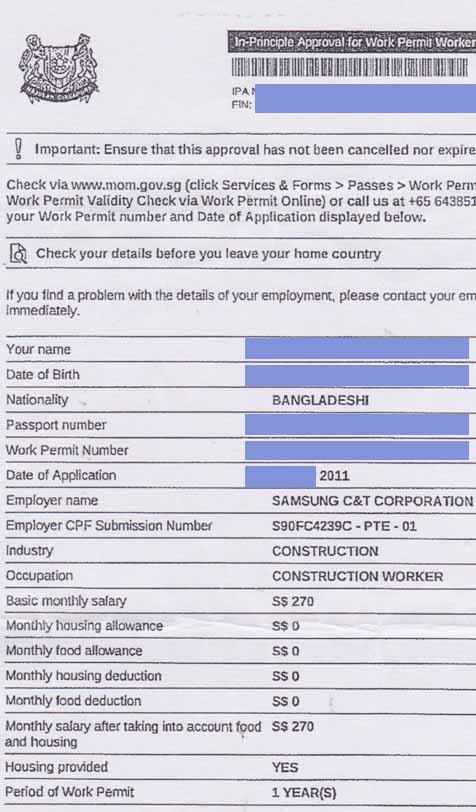
Shobus never would have agreed to a job that promised only $9 a day. But of course that’s not what he was promised before he came. He was told that he would earn $800 to $900 a month for working 8:00am to 7:00pm. He dreamed of how much he would earn by adding a few more hours of overtime. He thought this would be his break when his friend in Bangladesh asked for $4,100 to arrange a job with Samsung C&T Corporation. Only after he paid the full amount and received his ticket to fly from Dhaka to Singapore did he see the In-principle Approval for a work permit (IPA).

When he saw that the monthly salary listed on the IPA was $270, he asked S, his friend in Singapore who had arranged the deal, what he should do. S assured him that the figure wasn’t important, that they would work out a higher salary after he arrived. But when he arrived, S told him that if he complained that they’d both be sent back to Bangladesh. But not to worry, he’ll be sure to receive a raise after the first year.


Later he learned that some men who have worked with the company for over 3 years are earning only $9.50/day, and that the highest amount the company pays ordinary workers is $11/day.

Shobus has now worked for Samsung C&T since October 2011, and within that time has been able to send home $1,350. To achieve that he works 160 hours of overtime (OT) every month and takes no days off. Because the basic salary is listed as $270, the company divides by 30 (days in a month) to compute the salary at $9/day. Dividing that by 8 (basic work hours per day) works out at and hourly rate of $1.125, and multiplying that by 1.5 for overtime, the company pays $1.68 per hour as OT work. According to Shobus, the company pays no bonus, nothing for medical treatment, and nothing for medical leave.

When Shobus was ill with fever in December, he was not taken to see a doctor, and was not given any food in the dormitory where he rested for four days. He went on his own to visit a medical clinic and paid $90 for the consultation and medication.

Although Shobus’ daily work starts at 8:00am, all the workers must be ready and alert at 7:15 for group exercises, performed together with the dozen or so Korean office workers. This time is not included in the daily pay. The lunch break is computed at one hour, 12:00 noon to 1:00, but the workers have only half an hour to eat and rest. At 12:30 they must walk to the office some distance away where attendance is taken at 12:40. Immediately afterwards the 130 workers return to the job site to resume work.

The Employment Act states that, unless otherwise provided, an employee shall not be required to work more than 6 consecutive hours without a period of leisure, or more than 8 hours in one day or more than 44 hours in one week.

If an employee works more than 8 consecutive hours, he must have at least 45 minutes to have a meal. No employee shall be required to work more and 9 hours in one day or 44 hours in one week. If the number of hours in every alternate week is less than 44, the limit of 44 hours may be exceeded in the other week, but no employee shall be required to work more than 48 hours in one week or more than 88 hours in any continuous period of 2 weeks.

These restrictions are in place for the safety of the worker, and Shobus is well aware of the safety lapses that can occur when workers are given insufficient rest and food. He has seen his co-workers suffer injuries due to fatigue and lack of concentration, and knows men who have been denied proper treatment for their injuries.

Shobus works mainly outside, casting concrete, making drains, and pumping water. The Korean foreman Mr. Lee insists that everyone works, no matter what the weather. Occasionally Shobus works deep underground where there’s little oxygen. Air pumps and fans send air down, but not enough to penetrate the long narrow passageways where the men are expected to work, and they feel like they’re suffocating after only 30 minutes of that oxygen-poor air.

As told to TWC2 by Shobus, if Mr. Lee sees one man sitting down even though his work is finished, that man will be punished by receiving no work the following day, or by receiving no overtime work. If Shobus emerges from the tunnel due to lack of oxygen, Mr. Lee scolds him. When Mr. Lee finds that the man has gone to the toilet and is not on duty, he tells the others to call the missing worker back to his post immediately. Mr. Lee must be an asset to the company but he has no friends among the workers.

The money that Shobus sends home would not be possible without his working 24 hours at a stretch at least one day a week. During the day he is allowed a lunch break and 30 minutes for the evening meal, but no break between 7:30pm and 7:00am the following day. Each day, about 8 or 9 people do the 24-hour shift. They finish in the morning and are permitted to rest until 12:00 noon when they have a meal, before presenting themselves for the 12:40pm attendance and working until 10:00pm when attendance is taken again.

The men all complain about the quality of the food, as they recognise the importance of good nutrition in these circumstances. Shobus weighed 66 kg when he started working for Samsung C&T in October 2011. Now he weighs only 60 kg. Amazingly he retains the same cheerful smile and pleasant nature. There’s nothing enjoyable for him at this job, and yet he hopes to continue with this company for two years. He borrowed money to pay for the position and is willing to put up with the onerous nature of the job. He is more discontented with the low salary than with the long hours, and worries that this month, January, his salary will suffer due to the three holidays, New Year’s Day and the two Chinese New Year holidays. He’d be willing to stay longer if the salary were higher, he said.

If he continues working, he can send home $3,500 a year. The work permit lasts only one year so he has no guarantee that it will be extended, or that it will be extended without cost. The $4,100 that he borrowed requires interests payments of $250/month, which uses a large part of what he sends home. And still Shobus remains outwardly cheerful and optimistic. He lost $3,000 in a previous attempt to secure a job and is still hoping to recover that money. With each setback, work as a migrant labourer seems the only way out of the abyss of debt, and yet it keeps on growing for Shobus. That huge smile and genuine good nature belies his debt and financial hardship.

The link to the story: http://twc2.org.sg/2012/01/25/how-low-can-a-salary-go/

He fights for foreign workers

Yahoo! Newsroom
By Jeanette Tan | Yahoo! Newsroom – 41 minutes ago

Photo caption: Jolovan Wham is the executive director of HOME, an organisation that fights for the rights of migrant workers living in Singapore. (Yahoo! photo)

Under our "Inspiring People" monthly column, we highlight the incredible journey of one person who has overcome tremendous odds to achieve personal success. This column celebrates the triumph of the human spirit and we hope it will inspire you to reach for your dreams too. This month, we bring to you a man who pursues a not-so-lucrative career in helping a very large, but neglected, community.

Once some of you learn what 32-year-old Jolovan Wham does for a living, you might not take an immediate liking to him.

In a nutshell, he works full-time on one mission: to provide support to the expanding community of foreign workers living in Singapore.

As the executive director and one of the founding members of the Humanitarian Organisation for Migration Economics (HOME), Wham has for the past seven years reached out to migrant workers here to help fight for their rights.

Despite the groundswell of xenophobic sentiment among so many Singaporeans toward foreign workers, Wham took particular interest in them, even while in university.

“As a social work student I learned a lot about stuff involving Singaporean families and Singaporean issues, and it struck me that we had so many migrant workers among us and we weren’t talking about them,” he told Yahoo! Singapore. “So it started out as a kind of curiosity for me — what kind of problems and issues did they face? Why aren’t we talking about them?”

With this in mind, he volunteered once a month during his final year with the Commission for the pastoral care of Migrants and Itinerant people (CMI), the only group in Singapore dealing with migrant worker issues at that time. There, he spent two hours on one Sunday of each month at Lucky Plaza getting acquainted with Filipino domestic workers.

A new view on foreign workers

Wham’s interest in foreign workers’ issues was sparked at a young age. Having grown up in a family that hired domestic help, he remembers how his mother was once scolded for “spoiling the market” after deciding to give her Indonesian helper one day off each month.

“Even as a child, I thought to myself, ‘I didn’t want to go to school every day, so why should I expect my Indonesian maid to work for us every day of the week?’ So even back then, that logic made sense to me,” he said.

Why reach out to help foreigners and not locals? Wham dismisses the categorisation of “local” and “foreign” workers, arguing that people should be fighting for the rights of all workers here.

“I see it as a false dichotomy,” he says. “If we didn’t see them as different, we wouldn’t have this situation. They’re easier to bully, so employers continue to hire them because they accept much lower wages. It’s very frustrating,” he adds. “These people literally built this country. Literally… yet the kind of recognition we give them is disproportionate to their contributions.”

Abuse, exploitation, underpayment — Wham says he’s pretty much seen them all. He cites how some Bangladeshi cleaners live, sleep and cook in bin centres, earning about $15 for between 12 and 16 hours of work each day, and how many workers from China are forced to sign outrageous contracts that withhold pay or subject them to punishment, for example, should they file complaints with the authorities.

Photo caption: Parts of one of the dormitories that Jolovan Wham has visited. (Clockwise, from top left: The workers' laundry …

He says he has lost count of the number of construction workers’ dormitories he has visited, most of which are unlikely to ever sniff acceptable standards of sanitation or hygiene. He shares that one of the worst container blocks he visited required workers living there to squeeze into three beds stacked on top of one another — with 10 of these stacks crammed into a room that fits all 30 beds just nicely, leaving hope of having any available walking space zero to none — sleeping on wooden boards to reduce the number of bedbugs they would have to deal with, should they have mattresses.

He often has to pay late-night visits to the dormitories, where security is not as tight, taking pictures of the appalling state of living conditions so many of them are used to, and frequently submitting them to the Ministry of Manpower (MOM), whose representatives he is now familiar with.

“I don’t see myself as a pest. They do!” he says, laughing. “I always think I am giving constructive feedback.

More seriously, he points out, “It’s important to raise awareness, to hold those in power accountable for their actions. I speak out to effect change, to shape attitudes and opinions.”

Working every day, round the clock

His is pretty much a 24/7 occupation, saying he receives calls at 1am from workers on the brink of being forcefully repatriated after being dismissed, and has at times travelled to Changi Airport to help them negotiate with burly, gangster-looking men from repatriation companies.

“They usually refuse to let me talk to him (the worker), so I have to call the police, inform immigration officers of the matter; I have to insist that the workers are allowed to remain behind,” said Wham, who shared that he once sat down with a worker and the repatriation staff for more than an hour, refusing to leave until the latter gave up.

He admits, however, that it is often quite difficult to dispute their being sent back when salary issues or injuries are not involved.

“You get very disheartened, and I’ve had a lot of these kinds of setbacks,” he says. “It’s inevitable, it’s part of the work, and it’s going to be difficult for workers to realise their rights because of the way policies are,” he added.

Since beginning his outreach efforts with HOME in 2004, he has frequently found himself at the receiving end of strange looks, angry phone calls, news of complaints filed with the MOM and more.

“You’re dealing with a lot of people’s anxieties, you’re dealing with people who dislike you, employers who think you’re poking your nose into their business and agencies who say you’re siding with the workers and no one else,” he says.

In HOME’s first three years, Wham says they were frequently visited by angry employers of domestic workers who, with policemen in tow, demanded that they handed over their helpers to them.

Despite the intimidation, which he says he experiences “less often these days”, Wham says he simply explains “very rationally” to the employer that his or her helper does not belong to them, and that there is no law that says a maid is required to stay with her employer at all times.

“There’s nothing they can do. We haven’t violated any laws,” he says confidently.

Impact and recognition

Despite the challenges he and HOME face, the organisation helps between 1,000 and 1,500 foreign workers each year on various human rights issues.

“What we see is probably the worst of the lot,” he said. “We can’t say it’s indicative of the scale (of conditions faced by low-wage foreign workers here), but the fact that these do happen shows that there are gaps in our policies that need to be corrected.”

Yet, he estimates that the number of people HOME helps amounts to less than one per cent of the total number of foreign workers in Singapore now, which he believes should have hit — or even exceeded — one million by now.

“We only see these because they happen to find us,” he adds. “There are so many others out there who probably have no idea we exist.”

Wham’s passion for the cause has been recognised. Two awards were conferred upon him recently — independent political research initiative Think Centre gave him the Human Rights Defender Award, while The Online Citizen at its inaugural awards named him Social Worker of the Year 2011.

His joy at receiving these awards, however, comes partly from the knowledge that they help raise awareness for foreign workers’ plight.

“It adds recognition to the importance of the migrant worker cause. That for me is significant; it’s a cause that’s not very popular… so anything that helps to raise the profile of the issue is good,” he says.

Wham says he is driven by the stories of injustice and mistreatment he hears each day, whether or not he’s heard them before.

“I’m amazed at how I still get shocked and outraged (hearing these stories), even though it’s the same thing every day. I go to work with a sense of déjà vu,” he says with a laugh. “You need that anger, that sense of justice, otherwise it becomes another case… and you don’t do the work any justice.”

How low can a salary go?

From TWC2's website
Posted on January 25, 2012 


Shobus never would have agreed to a job that promised only $9 a day. But of course that’s not what he was promised before he came. He was told that he would earn $800 to $900 a month for working 8:00am to 7:00pm. He dreamed of how much he would earn by adding a few more hours of overtime. He thought this would be his break when his friend in Bangladesh asked for $4,100 to arrange a job with Samsung C&T Corporation. Only after he paid the full amount and received his ticket to fly from Dhaka to Singapore did he see the In-principle Approval for a work permit (IPA).

When he saw that the monthly salary listed on the IPA was $270, he asked S, his friend in Singapore who had arranged the deal, what he should do. S assured him that the figure wasn’t important, that they would work out a higher salary after he arrived. But when he arrived, S told him that if he complained that they’d both be sent back to Bangladesh. But not to worry, he’ll be sure to receive a raise after the first year.


Later he learned that some men who have worked with the company for over 3 years are earning only $9.50/day, and that the highest amount the company pays ordinary workers is $11/day.

Shobus has now worked for Samsung C&T since October 2011, and within that time has been able to send home $1,350. To achieve that he works 160 hours of overtime (OT) every month and takes no days off. Because the basic salary is listed as $270, the company divides by 30 (days in a month) to compute the salary at $9/day. Dividing that by 8 (basic work hours per day) works out at and hourly rate of $1.125, and multiplying that by 1.5 for overtime, the company pays $1.68 per hour as OT work. According to Shobus, the company pays no bonus, nothing for medical treatment, and nothing for medical leave.

When Shobus was ill with fever in December, he was not taken to see a doctor, and was not given any food in the dormitory where he rested for four days. He went on his own to visit a medical clinic and paid $90 for the consultation and medication.

Although Shobus’ daily work starts at 8:00am, all the workers must be ready and alert at 7:15 for group exercises, performed together with the dozen or so Korean office workers. This time is not included in the daily pay. The lunch break is computed at one hour, 12:00 noon to 1:00, but the workers have only half an hour to eat and rest. At 12:30 they must walk to the office some distance away where attendance is taken at 12:40. Immediately afterwards the 130 workers return to the job site to resume work.

The Employment Act states that, unless otherwise provided, an employee shall not be required to work more than 6 consecutive hours without a period of leisure, or more than 8 hours in one day or more than 44 hours in one week.

If an employee works more than 8 consecutive hours, he must have at least 45 minutes to have a meal. No employee shall be required to work more and 9 hours in one day or 44 hours in one week. If the number of hours in every alternate week is less than 44, the limit of 44 hours may be exceeded in the other week, but no employee shall be required to work more than 48 hours in one week or more than 88 hours in any continuous period of 2 weeks.

These restrictions are in place for the safety of the worker, and Shobus is well aware of the safety lapses that can occur when workers are given insufficient rest and food. He has seen his co-workers suffer injuries due to fatigue and lack of concentration, and knows men who have been denied proper treatment for their injuries.

Shobus works mainly outside, casting concrete, making drains, and pumping water. The Korean foreman Mr. Lee insists that everyone works, no matter what the weather. Occasionally Shobus works deep underground where there’s little oxygen. Air pumps and fans send air down, but not enough to penetrate the long narrow passageways where the men are expected to work, and they feel like they’re suffocating after only 30 minutes of that oxygen-poor air.

As told to TWC2 by Shobus, if Mr. Lee sees one man sitting down even though his work is finished, that man will be punished by receiving no work the following day, or by receiving no overtime work. If Shobus emerges from the tunnel due to lack of oxygen, Mr. Lee scolds him. When Mr. Lee finds that the man has gone to the toilet and is not on duty, he tells the others to call the missing worker back to his post immediately. Mr. Lee must be an asset to the company but he has no friends among the workers.

The money that Shobus sends home would not be possible without his working 24 hours at a stretch at least one day a week. During the day he is allowed a lunch break and 30 minutes for the evening meal, but no break between 7:30pm and 7:00am the following day. Each day, about 8 or 9 people do the 24-hour shift. They finish in the morning and are permitted to rest until 12:00 noon when they have a meal, before presenting themselves for the 12:40pm attendance and working until 10:00pm when attendance is taken again.

The men all complain about the quality of the food, as they recognise the importance of good nutrition in these circumstances. Shobus weighed 66 kg when he started working for Samsung C&T in October 2011. Now he weighs only 60 kg.

Amazingly he retains the same cheerful smile and pleasant nature. There’s nothing enjoyable for him at this job, and yet he hopes to continue with this company for two years. He borrowed money to pay for the position and is willing to put up with the onerous nature of the job. He is more discontented with the low salary than with the long hours, and worries that this month, January, his salary will suffer due to the three holidays, New Year’s Day and the two Chinese New Year holidays. He’d be willing to stay longer if the salary were higher, he said.

If he continues working, he can send home $3,500 a year. The work permit lasts only one year so he has no guarantee that it will be extended, or that it will be extended without cost. The $4,100 that he borrowed requires interests payments of $250/month, which uses a large part of what he sends home. And still Shobus remains outwardly cheerful and optimistic. He lost $3,000 in a previous attempt to secure a job and is still hoping to recover that money. With each setback, work as a migrant labourer seems the only way out of the abyss of debt, and yet it keeps on growing for Shobus. That huge smile and genuine good nature belies his debt and financial hardship.

Saturday, January 21, 2012

Better outreach, legislation to address employment malpractices

Letter from Farah Abdul Rahim Director, Corporate Communications, Ministry of Manpower
TODAY, Jan 21, 2012

In the letter, "More construction workers = more problems to deal with: TWC2" (Jan 14), Transient Workers Count Too expressed concerns about the projected increase in foreign worker numbers.

From the Ministry of Manpower's interactions with employees and employers, we have seen that most employers of foreign workers are responsible in fulfilling their obligations.

From December 2008 to December 2010, the number of foreign workers rose from 1,057,700 to 1,111,800. Yet, employment-related cases lodged with the MOM remained relatively stable except during the downturn years. Similarly, work injury cases also declined. This is due to: Better outreach to employers to raise awareness of their obligations, our concerted effort to improve workplace health and safety, and more active enforcement against errant employers.

Last year, 26 employers were convicted of Employment Act offences, of which 22 were for salary-related offences. Thirteen other salary arrears cases are now before the courts. For kick-back offences, nine individuals and one company were successfully prosecuted.

Nonetheless, some workers may continue to encounter irresponsible employers. We urge them to lodge reports with the MOM so that we could investigate and ensure that errant employers fulfil their legal obligations.

During investigations, the workers will be given access to temporary jobs where appropriate. Workers who are unable to provide for themselves and are denied help from their employers can approach the MOM and may be referred to non-governmental organisations such as the Migrant Workers' Centre.

The MOM will do more to address employment malpractices through legislation and education.

We are reviewing the Employment of Foreign Manpower Act this year to strengthen enforcement and hold employers and other stakeholders more accountable for the basic employment standards and well-being of foreign workers. We have engaged NGOs and stakeholders here for this review.

The MOM also educates foreign workers on their employment rights and sources of help, through various channels such as the key employment information in the In-Principle Approval letters sent to them in their home countries before they depart for Singapore.

We are piloting a series of pre-departure briefings on topics such as employment laws and terms for construction workers.

The MOM is committed to ensuring that the rights and interests of all workers are protected and upheld. We will continue to engage all stakeholders, including employers, unions, business associations, embassies of source countries and NGOs on this front.

Friday, January 20, 2012

Man charged with disposing of illegal worker's body

By Ewen Boey | Yahoo! Newsroom – 3 hours ago

Foreign workers don’t have it so good in Singapore.

On 30 March 2010, the body of Chelladurai Lenin, 42, was dumped along Upper Changi Road after he had died from head injuries – a fractured skull and internal bleeding in the head after falling from a construction site, wrote The Straits Times (ST).

His employer, furniture repair business owner Tay Kok Eng, 56, was charged on Thursday with dumping the body, as well as illegally hiring Lenin at his company, Midas Maintenance and Services, the paper said.

The news report stated that Lenin, who was from Chennai and had a wife and three children, died after refusing medical treatment as he would have been deported for being an illegal worker.

Tay faces a maximum of six months in jail and a S$2,000 fine for illegally dumping of a corpse, as well as another six months to two years of jail and another S$6,000 fine for hiring an illegal worker.

The foreign worker demand in Singapore is continually rising, especially in the construction sector, with the Housing Development Board (HDB) slated to release another 25,000 more BTO flats this year.

In a parliamentary report, Minister of National Development, Khaw Boon Wan, said that HDB needed about 18,000 construction workers for its building programme last year.

This is expected to increase to about 30,000 to meet this year’s building programme. As each building programme will take three to five years to complete, the cumulative requirement of construction workers could rise to 45,000 within the next few years.

Employer's death: Murder charge against maid reduced

Straits Times, Published on Jan 20, 2012

THE charge against an Indonesian maid accused of killing her elderly employer was reduced yesterday from murder to culpable homicide.

At a preliminary inquiry, 19-year-old Fitriah, also known as Vitria Depsi Wahyuni, was committed to stand trial for killing Madam Sng Gek Wah, 87, at her Serangoon Gardens home in 2009.

At first, the maid was thought to have been 23 years old at the time of Madam Sng's death, based on her identification documents.

However, it later emerged that she had changed her identity in Indonesia to get a job here and was, in fact, 16 years old at the time.

No reason was given in court for why the charge was reduced.

A hearing for Fitriah's plea to be taken has been fixed for Feb 15.

Represented by Mr Mohamed Muzammil Mohamed, she indicated that she would plead guilty.

She is accused of strangling Madam Sng some time between 8pm on Nov 25 and 3.15am on Nov 26, at the elderly woman's house in Farleigh Avenue.

Fitriah is reported to have left the house at about 3am. She stopped a taxi and asked the driver to call the police.

It is understood that she had been working for Madam Sng for less than a week.

If she is convicted of culpable homicide, she could be jailed for life, or up to 20 years, and fined.

Man charged with dumping worker's body

Straits Times, Published on Jan 20, 2012

By Fiona Low

THE owner of a furniture repair business was yesterday charged with dumping the body of a foreign worker on a pavement along Upper Changi Road in 2010.

Tay Kok Eng, 56, is also facing a second charge of hiring the man, who was an illegal immigrant, to work as a helper in his company, Midas Maintenance and Services.

According to previous news reports, the body of Mr Chelladurai Lenin, 42, was found abandoned by the roadside on the night of March 30, 2010. He had died from a fractured skull and bleeding in his head.

The Indian national reportedly fell at a construction site but did not want to be sent to hospital because he was working in the country illegally and was afraid of being deported.

Mr Chelladurai was married at the time to Madam Kunjathammal, then 36, and they had three children. The family lived in Chennai.

In an interview in 2010, Madam Kunjathammal said she had not heard from her husband since he came to work in Singapore in 2000. She found out about his death only when she got a call informing her that he had an accident at work.

If convicted of illegally depositing a corpse, Tay could be jailed for up to six months and fined up to $2,000. For hiring an illegal worker, he could be jailed between six months and two years and fined up to $6,000.

In 1997, a Bangladeshi illegal worker was dumped in a monsoon drain after he was injured in a worksite accident. The then 24-year-old Mohamad Bashar had been working at a construction site when he was hit by a descending lift, leaving him paralysed from waist down. His employers then drove him to a forested area off Jalan Ulu Sembawang and left him there.

Mr Bashar was rescued about three hours later when the occupants of a passing military jeep heard his cries for help.

Two of the three men who dumped him there were sentenced to 18 months and 15 months in jail. The third man jumped bail after he was charged.

Thursday, January 19, 2012

Fewer break rules on ferrying workers

by Sumita Sreedharan
TODAY, Jan 19, 2012

Photo caption: Workers on the back of a pick-up truck. TODAY FILE PHOTO

SINGAPORE - Fewer offenders were caught not complying with safety rules for ferrying workers on lorries from February to September last year, with the number dropping 49 per cent to 1,329 after stiffer penalties kicked in in February last year.

Minister of State for Transport Josephine Teo said this in Parliament yesterday in response to queries by Chua Chu Kang GRC Member of Parliament (MP) Alex Yam.

Mrs Teo also said the number of accidents in the eight months before and after enhanced penalties took effect also fell.

The number of fatalities fell from five to zero and the number of injuries dropped to 83 cases from 199 cases.

The Land Transport Authority had implemented a set of rules to enhance the safety of workers being transported in the rear of lorries and pick-up trucks, following accidents involving workers being ferried in such a manner.

MPs also expressed concern that these lorries were being used to send workers from their lodgings to transport hubs instead of their workplaces. Mr Yam asked if this matter was covered under the rules and if there were penalties for it.

Mrs Teo replied that there are "currently no restrictions against transportation of such nature".

On whether it adds to the strain on public transport, Mrs Teo said: "We do not encourage employers to overextend the use of the public transport for their workers travelling between workplaces."

Nee Soon GRC MP Lee Bee Wah echoed Mr Yam's queries, saying she has received feedback from her residents on the matter. She asked if contractors were allowed to let their workers use public transport "when it is already so packed".

Mrs Teo said public transport is meant for public use, but the Government "would be willing to take a look at this problem and where necessary work with the employers to reduce such incidents".

parliament - Lorry safety offences fall 49% with stiffer penalties

Straits Times, Published on Jan 19, 2012
By MARIA ALMENOAR
Photo caption: No workers died in the eight months after the new rules kicked in, compared with five in the eight months before. -- ST PHOTO: ALPHONSUS CHERN

STIFFER penalties designed to protect workers transported on the backs of lorries seem to have had the desired effect.

The number of employers caught for flouting safety rules between February and September last year was 1,329.

This is 49 per cent lower than the 2,601 caught in the eight months before the stiffer rules were implemented on Feb1 last year.

In Parliament yesterday, Minister of State for Transport Josephine Teo gave an update on the effectiveness of the new rules while responding to questions by MP Alex Yam (Chua Chu Kang GRC).

Since February last year, all light lorries ferrying passengers in the back have been required to have canopies and higher side rails. Owners who do not comply can be fined up to $1,000 or jailed for up to three months.

The number of accidents involving workers in the backs of lorries was also down over the same period. There were five fatalities in the eight months before the new rules took effect, and none in the eight months after.

The number of injuries was also reduced, from 199 cases to 83 cases.

Mr Yam and MP Lee Bee Wah (Nee Soon GRC) also asked if there were rules against employers ferrying workers to MRT stations or bus interchanges so they could then take public transport to work, and if this was adding to the already heavy load on public transport.

Mrs Teo replied that there were no restrictions against employers providing such transport.

'The very nature of public transport must mean that the public can use it. Whoever you are, working in Singapore, living in Singapore, whether you are a tourist, you can use public transport,' she said.

However, she added that the ministry did not encourage employers to overextend the use of public transport for foreign workers travelling between workplaces, and was open to working with businesses and MPs who had specific problems with this issue.

Wednesday, January 18, 2012

Woman charged with 12 counts of maid abuse

Straits Times, Published on Jan 18, 2012
By Elena Chong

Photo caption: Chan Huey Fern, 31, allegedly used objects such as a foldable chair and an umbrella to hit her maid. -- ST PHOTO: WONG KWAI CHOW

A woman was charged with 12 counts of abusing her Indonesian maid over a nine-month period in 2010.

Chan Huey Fern, 31, allegedly used objects such as a foldable chair and an umbrella to hit Ms Juwarti at her home in Buangkok Link.

Apart from allegedly pushing, punching and kicking her, she is also said to have pushed the maid's forehead causing it to hit against the wall, used her leg to stamp on her chest and caned her on the legs.

No plea was taken from Chan, who was represented by Mr John Tan.

The case was adjourned to Feb 22.

If convicted, she can be jailed for up to 3-1/2 years and/or fined up to $7,500 per charge.

Crane topples over at construction site

Straits Times, Published on Jan 18, 2012

A MOBILE crane tipped over at a construction site in Simei yesterday, hitting the top level of a multi-storey carpark that was being upgraded.

The incident happened near Block 116, Simei Street 1 at around 6.30pm. No one was injured.

The crane operator, Mr Mohamad Noor, said he was hauling cement and concrete from the ground to the third level when the crane started to topple over.

The 57-year-old, who has 'a few years' of experience operating cranes, said the bucket may have been overloaded at the time.

The crane, hired from Hiap Tong Corp, had been in operation at the site since Monday.

Ms Abby Marzuki, 28, a resident of nearby Block 111, said she was resting at home when she heard a loud thud.

'I thought it was thunder at first until my neighbour told me that a crane had collapsed.

'When I came to the scene at about 7pm, there was an ambulance but it left after they found out that nobody was injured,' she said.

LIN WENJIAN

Investments still flowing in despite foreign worker curbs

Straits Times, Published on Jan 18, 2012
By Robin Chan

Photo caption: The Government's decision to restrict the number of foreign workers coming to Singapore has not made the Republic unattractive to companies, said EDB chairman Leo Yip. -- ST FILE PHOTO

THE decision to restrict the number of foreign workers coming to Singapore has not deterred large global companies from continuing to invest here, said Economic Development Board (EDB) chairman Leo Yip.

'We interact very closely with companies around the world. I don't think, thus far, there is any concern that Singapore is changing its economic direction,' he said at a press briefing yesterday at EDB's headquarters.

'We remain connected to the global economy and we understand that is the way we will continue to grow and be competitive - remain connected and open to business from around the world.'

The EDB brings in investments from global companies such as Shell and Procter & Gamble.

Singapore has recently introduced various measures, including a restriction on the number of foreign workers in the workforce. With the Government also introducing the additional buyers' stamp duty for home purchases, there are some concerns that the Republic is becoming less open to foreigners and foreign investments.

Dr Chua Hak Bin, an economist at Bank of America Merrill Lynch, said at an Institute of Policy Studies forum on Monday that Singapore was becoming less open than before. Restrictions on foreign labour, he added, would lead to a 'hollowing out' of the manufacturing sector in Singapore - or to factories moving out due to rising costs.

But Mr Yip said no companies had left or threatened to leave Singapore, because of more difficulties accessing foreign workers.

'No, it has not come to our attention that (foreign worker curbs)... have made Singapore so unattractive,' he said. 'Companies understand that there is an amount of restructuring that they have to do in Singapore.'

He also disagreed that the manufacturing sector is hollowing out. 'Many of the investments continue to be in manufacturing. but the nature and profile of manufacturing is changing, it's a lot more knowledge-intensive and high value-added.'

EDB managing director Beh Swan Gin said that from 2001 to 2010, while Singapore's population grew from four million to five million, employment in the manufacturing sector increased by only about 55,000 to 60,000 workers.

'In other words, it was really growth that was very much based on productivity, because manufacturing output in those 10 years has also grown quite significantly. This is to prove the point that some changes in foreign worker policy is not going to hit the manufacturing sector too hard.'

He added that the Government's 1 per cent to 3 per cent economic growth forecast for this year is realistic. 'In electronic manufacturing (which makes up a third of total output), many don't have visibility on the first two quarters of 2012, which means you have to be more conservative in your manufacturing estimate. Past the second quarter, if numbers do show a rebound, we could all have a spot of good news,' he said.

A bright spark will be the offshore and marine sector, with its strong order book that will help keep factory output 'fairly reasonable', he added.

Foreign workers roped in to queue for bak kwa

Straits Times, Published on Jan 18, 2012
By NG KAI LING

Photo caption: Foreign workers queueing up at Lim Chee Guan in New Bridge Road yesterday afternoon. -- ST PHOTO: NG KAI LING

Instead of toiling at the construction site, Indian national Pasopolgti Sai Babo spent much of Tuesday in a long queue waiting to buy bak kwa.

He was one of about 10 foreign workers spotted in the queue of about 150 people at popular barbecued meat seller Lim Chee Guan's New Bridge Road outlet.

The workers told The Straits Times that they were dropped off in the morning by their bosses and told to stand in line for bak kwa.

Mr Pasopolgti joined the queue at 6.30am, and finally got his hands on 10kg of bak kwa after eight hours in the queue. 'My boss told me to come, so I came, cannot argue. I'm very tired,' said the 42-year-old, who works for a construction company.

A spokesman for Lim Chee Guan said bosses have been sending their workers to buy bak kwa for a few years now.

She added: 'Some workers come in groups. About eight groups of workers came today.'

One group of eight workers in the queue at 3pm on Tuesday was from construction company Yongnam Holdings.

Foreman Hoe Koon Seng said he had gathered seven workers to queue with him because he needed to buy 50kg of bak kwa for his bosses to give away to business associates.

'I was not sure how much each person can buy, so I called more workers,' the 56-year-old said.

At Lim Chee Guan on Tuesday, each person could buy up to 20kg of bak kwa. Each kilo of sliced pork bak kwa was selling for $50.

Asked if they still needed to go back to work, another Indian construction worker Mokles Ur, 24, said: 'This is work. We have been queueing since 8am.'

Mr Teo Ang Soon, who works for his family's construction company, also brought a foreign worker along.

'I do this every year. I buy about 20kg, so I need someone to help me carry it,' he said in Mandarin.

Asked if his worker would be given a day off, he said: 'I gave him two days off - today and tomorrow. But tomorrow he doesn't need to queue.'

Tuesday, January 17, 2012

Duo accused of smuggling in Chinese national

Straits Times, Published on Jan 17, 2012

Photo caption: Inspector Isham Mohamed (left) and Station Inspector Daniel Tan(right) were part of the Police Coast Guard team that arrested the two Singaporeans and Chinese National Lu Yunlan last Saturday near Punggol Jetty. -- PHOTO: LIANHE ZAOBAO, STOMP

TWO Singaporeans were charged yesterday with smuggling an illegal immigrant into Singapore.

Chua Kim Hai, 56, and Andrew Cheng, 40, were caught after allegedly dropping off a Chinese national on a beach near Punggol Jetty last Saturday night.

Yesterday, they were charged with conveying a prohibited immigrant to Singapore in a vessel.

The two men had allegedly picked up Chinese national Lu Yunlan, 37, from another boat, off the north-western coast of Pulau Ubin at about 9pm on Saturday night.

Unknown to them, their activities were being watched by the Police Coast Guard (PCG) using night surveillance equipment.

Shortly after the transfer, Chua, Cheng and their passenger sped towards Singapore's shore in the modified sampan they were in, the PCG said.

A PCG craft went after the sampan for about 1.2km.

The sampan then pulled up on the beach next to Punggol Jetty, where Lu jumped off the boat and ran towards the forested area.

By then, officers from a police post near the jetty had already been alerted.

The officers watched her as she hid in the bushes.

As Chua and Cheng sped away, another PCG vessel chased after them for about 800m, before they slowed down and surrendered.

Lu was later arrested at 10.25pm, after police officers found her hiding in the bushes.

Yesterday, she was charged with entering Singapore without being in possession of a valid pass lawfully issued by the immigration authorities.

When she was arrested, she had a Chinese passport on her.

However, the passport did not contain the relevant immigration stamps.

Fewer illegals nabbed trying to enter Singapore by sea

Fall in numbers due to increased barriers and patrols, crackdown on smuggling syndicates
Straits Times, Published on Jan 17, 2012
By Tham Yuen-C

FEWER illegal immigrants have been caught trying to sneak into Singapore by sea following the arrest of several human-smuggling kingpins.

Fifty-four people were picked up at the Republic's sea borders last year, a fall from 72 in 2010 and 85 in 2009.

Police Coast Guard commander Teo Kian Teck said the drop was due to efforts to crack down on people-smuggling syndicates.

'The numbers (of illegal immigrants) have fallen because of the deterrent effect generated from the several arrests in the last three years,' the senior assistant commissioner told a press conference in Loyang yesterday.

'But we must continue to watch them because there is a constant supply of people wanting to come to Singapore,' he added.

The smuggling kingpins included Chinese national Wu Fengxia, who operated out of Putian in Fujian province.

His arrest in February last year crippled a major network that has smuggled at least 200 illegal immigrants into Singapore in the last six years.

Wu's modus operandi was to fly them into Malaysia, then ferry them across the Strait of Johor.

Most of the illegal immigrants caught trying to enter Singapore by sea last year used this method. More than 80 per cent of them attempted to get in via the same route from the Republic's northern coast.

Many of the illegal immigrants came from China. Others arrived from Bangladesh and Myanmar, using Malaysia as a transit point.

About 20 per cent of those arrested last year had tried to enter Singapore from the southern coast. Most were Indonesians.

To deter illegal immigrants, the coast guard has set up 48km of land and sea barriers in recent years. Floating drums are tied together and put at the mouth of channels to prevent boats from zipping in and dropping off their illegal passengers.

The barriers have been placed in areas such as Pasir Ris Beach, Jurong Island Causeway and Tanah Merah Ferry Terminal.

Even if the people smugglers get past these defences, they will have to contend with steel fences with barbed wire covering part of the coastline.

A total of 68km of barriers will be in place when the project is completed in three years.

Increased patrols also helped to slow down the smuggling syndicates.

Sneaking in via the sea route has become less popular among illegal immigrants, judging by the decrease in suspicious activity spotted at Singapore's sea borders.

Last year, the coast guard noticed fewer unlit vessels loitering in the small hours. There were 160 sightings, a drop from 220 in 2010 and 284 in 2009.

Border security was identified as a top concern after the November 2008 attacks on Mumbai. Terrorists arrived at the Indian city by sea and stormed hotels, killing 166 people, including a Singaporean.

IPS SEMINARSocial mobility, lifting median wages key, says Tharman

Effort to tackle problem of income inequality goes back several years
Straits Times, Published on Jan 17, 2012
By Robin Chan

DEPUTY Prime Minister Tharman Shanmugaratnam yesterday outlined three ways the Government is addressing the challenge of inequality and preserving an inclusive society in Singapore.

The Government wants to continue creating opportunities for social mobility, prevent incomes in the lower and middle income brackets from stagnating, and achieve a progressive policy of income redistribution to help the poor, he said.

But this must be supported by a social compact where the better-off have a sense of obligation to help the less fortunate, and it must be done without eroding the sense of value of working hard and looking after one's family.

Mr Tharman was the guest of honour at Singapore Perspectives, the annual forum organised by the Institute of Policy Studies, held at the Suntec City Convention Centre yesterday, where panellists spent the day discussing the issue of rising inequality in Singapore.

Mr Tharman, who is also Finance Minister and Manpower Minister, said that the effort to tackle the problem of inequality and inclusiveness was not a recent shift that came about after the general election last year.

'This is something we've been thinking about very hard for several years now. We made a major shift in 2007 when we embarked on Workfare, not just as a technicality, but a shift in a way we want to preserve an inclusive society.'

The rise of China and India has depressed wages at the low end and has taken away jobs and skills in the middle income bracket all over the world through globalisation, he said.

'We have to try to avoid that outcome in Singapore, we have to try to avoid the stagnation of median wages, which has afflicted most of the developed world over the past decade,' he said.

But Singapore, as a small and open economy, will inevitably have a higher 'Gini coefficient' - a common measure of income inequality - than most large countries.

'That's our fate in life. We are small, we can only survive and do well by staying open, but it brings inequality,' he said.

'So Gini coefficients and other indices that we look at will tend to be higher than most large societies but not very different from Hong Kong, London and key American cities, or even the key Chinese and Indian cities, Beijing or Shanghai, all of which have higher Gini coefficients than Singapore.

'That's not a source of comfort for us but it is a fact of life as a global city, somewhat higher degree of inequality.'

He said the basic factors to address inequality remain: social mobility and lifting wages of low and middle-income earners.

But this must be complemented with the progressive redistribution of income through taxes and transfers and without overburdening the middle-income group.

'How can we maintain a progressive slant - where the bulk of the benefits are delivered to those at the low end of the social ladder and the bulk of the taxes are paid by those at the upper end?' he said.

'While ensuring that we remain a society where at the core, people do have a sense of responsibility for their families, they do want to work hard to improve themselves, and do take pride in being part of a society where everyone moves up that way?'

So far the Government has managed this by intervening in the right areas - education, the workplace, housing and health care - while keeping taxes low, he said.

'That has to remain a distinct feature of our fiscal system - to try to avoid increasing the burden on the middle class.'

Doing all this requires an activist state, and he said the Government has shown it is far from being 'market fundamentalist' or one that believes only in letting market forces go to work.

'We are willing to intervene aggressively when we feel it is right to keep social mobility going and to redistribute in a way that ensures the ethic remains in place.'

These social interventions include early help for the young from broken families, trying to keep them in school and away from drug problems, and supporting the elderly struggling with a rapid rise in living costs.

And he added that 'no policies are sacrosanct'.

'We keep refining them every few years, make some significant shift in what we think is the right direction, always instructed by empirical evidence, always look for what's actually working now, encourage what's working out well, do away with what doesn't work out. Keep that empirical bias in our social and economic policies.'

He urged critics to put Singapore's income inequality challenge in perspective, noting that the Republic's median income growth has been faster than Britain, Hong Kong, Taiwan and South Korea, and that the nation also has a strong fiscal position to tackle problems.

'Very important is we have a fiscally sustainable set of solutions. Unlike countries that used their youthful years and rapid growth years to build up spending in excess of revenues and now find themselves trapped with high debts,' he said.

'We have to keep this position of strength as we can address the challenge of helping the elderly and the challenge of keeping social mobility going.'

***
Q & A: On foreign workers, elitism and unhappiness
Straits Times, Published on Jan 17, 2012

The open-door policy [to foreign workers] is the source of some of our economic difficulties. How aggresively can we expect the Government to address them?
- Socio-political blogger Alex Au

We are an independent country that needs a relatively diversified economic structure. We cannot be a pure services centre like HK, which does most of its manufacturing across the border. We need a manufacturing sector, a logistics sector and we need a range of services to survive as an independent city-state. And that means we are not going to have Singaporeans in adequate numbers and with the right skills in every sector. If we want more them in construction, we have to do with less Singaporeans in other sectors.

So inherent in keeping to a diversified economic structure with a relatively small domestic workforce is that in each sector you need a varying amount of foreign workers. Then the challenge is to gradually tighten that, gradually improve the quality of foreign workers, and improve the quality of our own people at the same time. But we cannot shift to the extreme end of the spectrum where you only rely on local workers.

Our education system promotes the creation of an elite which goes against the very idea of an equal society... how do you reconcile the two?

Take my answer as random reflections rather than government policy. It is a very important question, because too much precision at too early an age does favour those who start off with more advantages. What we've been doing in recent years is moving towards some blurring of meritocracy... I do think we still have to move further in the direction of blurring the precision of scoring and placing into secondary schools. And we have to think about how we can do it without offending the sense of fairness that Singaporean parents have. If one parents' kid had 257 (PSLE score) and another parents' kid had 255 and got into the school they were competing for, the first parent gets upset. So we have to find ways of blurring this in a way that doesn't upset that sense of fairness in the Singapore system.

We live in a good society, we've done very well, but why are Singaporeans so unhappy?
- Professor Tommy Koh

We are going through a transition. The adjustments have been sudden not just in Singapore but everywhere else. An adjustment to a new set of economic circumstances, the fact that incomes are not going up as fast as before; and the fact that the sense of mobility that you got from the first 30 years, where there was a whole leap in living standards in each generation, that has slowed. And we have to adjust to that and find a new compact and a new understanding amongst everyone who is involved.

Secondly, we are going through a transition politically. From a very dominant, incumbent party, to more plurality, more voices and views in and out of parliament.

Over time things will settle. The underlying drivers, however, will not change - it is a very competitive world; but we also have to do more to help those at the lower end of the ladder.

Most important is to keep this as a place where people feel there is a realistic chance for them to improve over time. And I think this is one of the few places where, despite being relatively developed, we can achieve that - an upward, mobile society. And that will keep a sense of optimism about the place. And politically too, as a ruling party, we have to manage our incumbency somewhat better than we had in the past.

Saturday, January 14, 2012

Worker who threatened suicide jailed for trespass

He wanted employer to compensate him for alleged injuries
Straits Times, Published on Jan 14, 2012
By Khushwant Singh

Photo caption: Ai told police he never intended to kill himself, but wanted to scare his employer. -- PHOTO: SINGAPORE POLICE FORCE

FOR 3-1/2 hours, a Chinese national clung onto scaffolding seven storeys high and in heavy rain. He threatened to jump to his death unless his employer gave him $15,000.

Ai Yong Li wanted the money as compensation for back injuries he claimed to have suffered while working for Yangzijiang International, a sub-contractor doing work at a project near Holland Village.

Yesterday, Ai, 35, was jailed 2-1/2 months by a district court after pleading guilty to committing criminal trespass in the incident last year.

He told investigators that he never intended to kill himself and had threatened suicide only to scare his employer into paying him.

In passing sentence, District Judge Low Wee Ping told him: 'All disputes, whether between employee and employer, whether legitimate or not, have to be resolved through rule of law.

'What you have done is to blackmail your employer. That has no place here.'

Deputy Public Prosecutor Zhong Zewei said Ai had sneaked into the construction site of Holland Residences in Taman Warna on Oct 19 at 11.40am while off duty.

He went up to the seventh floor of an incomplete block of apartments, where a security supervisor saw him holding on to the scaffolding without any safety equipment.

Ai refused to budge and threatened to leap off unless he was given $15,000.

Police and civil defence officers were called in and an airbag was quickly put in place in case he fell.

Parts of several roads were also closed to traffic.

As Ai was adamant, a site foreman went up and handed him $12,000.

Only then did the disgruntled worker come down.

He was arrested and the money was seized by police.

Last July, another Chinese national who perched himself atop a 30m-tall crane and refused to come down until a pay dispute was settled was jailed for five weeks for criminal trespass in the same district court.

Yang Wei, then 27, had pleaded guilty to trespassing at the Nakano construction site in Changi South Avenue 2 on the morning of July 4.

He came down two hours later after receiving $5,000 which he claimed his employer, Zhong Jiang International, owed him in overtime pay, medical expenses and repatriation costs.

In asking the court for a stiffer sentence, DPP Zhong said Ai's case was more serious as much inconvenience was caused by the road closures.

Also, substantial police and civil defence resources had to be deployed, he added.

He argued that Ai had disregarded legal avenues to resolve his complaints against his employer.

The court ordered the $12,000 to be returned to the employer.

The maximum penalty for criminal trespass is a $1,500 fine and a three-month jail term.

****
Injury cases: Go to MOM, say help groups
Straits Times, Published on Jan 14, 2012
By Lin Wenjian

WORKERS injured at work should seek help from the Ministry of Manpower (MOM) instead of taking the law into their own hands, say help groups for migrant workers.

They were commenting on the case of Chinese national Ai Yong Li, 35, who was jailed 2-1/2 months yesterday for criminal trespass, after breaking into a construction site and threatening to jump to his death last year.

Ms Bridget Tan, the president of the Humanitarian Organisation for Migration Economics (Home), said workers in a similar predicament should file an injury claim with MOM 'as the enforcement has to come from the ministry'.

'If these workers are desperate and not sure what they should do, they can come to us for help,' she said.

Home handled between three and five injury-related cases a week last year and wrote to the ministry on behalf of the workers.

Home's executive director, Mr Jolovan Wham, said: 'Most of these workers come to us because they have no money for survival - they can't work and they are not paid their medical leave wages by their employers.'

He thought that Ai might have been driven to desperation.

'These workers usually feel that nobody is helping them with their problems and decide to do things their way.'

Ms Tan added that Home usually refers such workers to counsellors or pro-bono lawyers if necessary.

Transient Workers Count Too (TWC2), another help group for migrant workers, saw an average of 70 cases of injury-related claims a month last year. Back injuries made up one-third of the total.

Its spokesman, Mr Alex Au, said that unlike on other parts of the body, back injuries are less visible and employers are often tempted to dispute their workers' claims.

'The employers start with the view that the workers are exaggerating, which is wrong because it is not in their interest to malinger as they can earn more money by working,' said Mr Au.

Meanwhile, the Migrant Workers Centre (MWC) said its officers handle about 20 cases of work-injury complaints a year.

Mr Edwin Pang, its executive director, said it takes up the cases with MOM, as well as the employers and insurers.

He added: 'If money is needed for post-operative nursing care, or interim housing and meals, MWC will consider stepping in on a case-by-case basis to assist.'

***

Helplines for workers in distress

# MIGRANT WORKERS CENTRE

Address: 62 Rangoon Road

Tel: 6536-2692 (9am to 7pm

Tuesdays to Fridays; 11am to 3pm on weekends)

# HUMANITARIAN ORGANISATION FOR MIGRATION ECONOMICS (Home)

Address: 711 Geylang Road, #03-03 Oriental Venture Building

Tel: 1800-797-7977

# TRANSIENT WORKERS COUNT TOO (TWC2)

Address: 5001 Beach Road, #06-27, Golden Mile Complex

Tel: 1800-888-1515 (10am to 5pm on weekdays)

Maid jumped to death after she was caught stealing

Straits Times, Published on Jan 14, 2012
By ELENA CHONG

A MAID leapt to her death from the eighth floor of a block of flats after she was caught stealing, an inquest heard yesterday.

Ms Shaik Razzia, 25, was found lying at the void deck a day after confessing to taking $95 and other valuables from her employer's wife.

The court heard that the Indian national came clean after a pouch containing the stolen items was found in her room.

That evening, the couple noticed that she was having trouble sleeping. The husband checked her room the next day, but could not find her.

While searching the surrounding area, he came across police at the void deck, who told him the maid had fallen to her death.

Ms Razzia had spent seven months working for 37-year-old software engineer Kotha Lakshmana Rao and his wife, Madam Chalamalasetti Venkata Naga Rama Jyothi. They were her first employers in Singapore.

After she had been with them for a while, cash and valuables began to go missing from the flat in Bukit Batok West Avenue 6. So on May 26, Madam Jyothi decided to search the maid's room while she was out at the park with the couple's two young sons.

The 33-year-old quality assurance executive found the pouch hidden inside a cushion, and later confronted her.

At first, the maid denied stealing from the Indian couple, who are both permanent residents. But when shown the pouch, she confessed.

The coroner said in his findings that she had fallen from the eighth-floor common corridor with intent to end her life. Her employers were in court but declined to comment.

Caught stealing, maid jumps to her death

by Alvina Soh
TODAY, Jan 14, 2012

SINGAPORE - A foreign domestic worker took her own life after she was caught for stealing by her employers on May 27, last year. A coroner's inquiry into the death of 25-year-old Shaik Razzia revealed she jumped to her death from the eighth floor corridor of her flat at Bukit Batok West Avenue 6.

The night before, Ms Chalamalasetti Jyothi and Mr Kotha Lakshmana Rao discovered their missing cash and valuables in the maid's room, including a pouch containing S$95 hidden within a cushion.

Shortly after, they confronted Shaik Razzia, an Indian national, who confessed to stealing the items over the past several months. She was later observed by Ms Jyothi to have trouble sleeping that night. The next morning, Shaik Razzia was discovered missing. Mr Rao learnt of her death when he ran into the police at the void deck. An autopsy report revealed Shaik Razzia died of multiple injuries sustained from her fall.

State Coroner Imran Abdul Hamid, who agreed with the report, said there was no evidence of foul play. It is not known how long the foreign domestic worker has been working in Singapore. Alvina Soh

Man who threatened boss jailed for trespass

by Alvina Soh
TODAY, Jan 14, 2012

SINGAPORE - A Chinese national, who had threatened to commit suicide at a construction site he had trespassed, was sentenced to 10 weeks' jail, yesterday.

Ai Yong Li, 35 had committed the rash act to scare his supervisor into paying him S$15,000. The former construction worker was found guilty of one charge of criminal trespass after he entered the site at Taman Warna on Oct 19 last year.

He had climbed the external scaffolding on to the seventh and highest floor without any safety equipment.

An on-site security supervisor spotted him but Ai refused to heed his instructions to come down. Instead, Ai demanded that his former employer, senior project manager Mu Yafei, meet him at the rooftop with S$15,000, or he would jump.

The court heard the money was compensation for work-related injuries Ai had supposedly suffered.

Ai came down only after being handed S$12,000 by Mr Mu, nearly four hours after he first went up the scaffolding.

Deputy Public Prosecutor Zhong Zewei said Ai "had no intention of killing himself but was merely threatening to do so" in order to get his former employer to comply with his demands.

For criminal trespass, Ai could have been jailed three months, fined S$1,500 or both. Alvina Soh

More construction workers = more problems to deal with: TWC2

Letter from Russell Heng President, Transient Workers Count Too
04:47 AM Jan 14, 2012

The National Development Minister has said that, with the Housing and Development Board (HDB) accelerating its building programme, the number of construction workers needed for this is expected to increase to 30,000 this year, from 18,000 last year.

The number could rise to 45,000 beyond this year. Transient Workers Count Too (TWC2) is concerned that systems are not in place to effectively handle the migrant worker problems that are likely to be a side effect of these numbers.

Last year, 100 to 200 workers came to us monthly with complaints about mistreatment, such as workplace injuries, unpaid salaries, unjust deductions, illegal deployment and job placement scams.

Workers are left to languish for months, sometimes for more than a year, while their cases wend through the bureaucracy. Typically, they would have been terminated from their jobs because employers do not want to continue paying the levy.

Yet, the men are not allowed to engage in alternative work. They are left destitute and often homeless, depending on charity.

TWC2 has pointed out to the Ministry of Manpower (MOM) that the difficulty in coping with even the present number of workers lies in three broad failings.

First, current laws give too much leeway to employers or have many loopholes that disadvantage foreign workers and encourage employers to cheat or mistreat and then abandon them.

Second, existing laws are often not enforced, so employers believe that they will succeed when they try to escape their legal obligations to their workers.

Third, many administrative policies, for example, the preference for repatriation instead of retention and transfer of workers, worsen the problem. Labour churn may line the pockets of employment agents, but they hurt everybody else's interests.

There should be strong incentives to retain workers and stronger disincentives to terminate and repatriate them. Upskilling programmes would be defeated if workers are sent home too quickly, only to be replaced by a fresh batch.

Yet, without upskilling, Singapore would always rely on large numbers of low-skilled labour, with its attendant social friction.

TWC2 has also been vocal about the need for the police to be more vigilant against repatriation agents' strong-arm tactics on behalf of employers and against the growing number of scams whereby workers are promised non-existent jobs.

We are concerned that news of the increasing need for workers for HDB projects would tempt scammers to expand their operations.

If the same percentage of workers are injured or mistreated when the number hits 45,000, there would be a significant increase in caseload.

Ahead of the HDB's ramp-up in projects, we urge the MOM and other departments to look critically at the present inadequacies for dealing with injuries, employer-employee disputes and job scams.

We urge various government agencies and Members of Parliament to dialogue intensively with non-government organisations working hands-on at the front line of the issues, so as to quickly do what is needed to prevent a tsunami of migrant worker cases.

Thursday, January 12, 2012

Foreign worker hanged himself after losing work permits

(Updated: Thurs 6.48pm, added Ministry of Manpower’s comments)
By Faris Mokhtar | Yahoo! Newsroom

A 20-year-old foreign worker who was found hanged last year killed himself out of guilt for unwittingly getting friends involved in a scam, a court heard on Wednesday, according to media reports.

In October, Bangladeshi national Md Roni Miya Md Rajaul Karim introduced five friends of the same nationality to a contact named Pabal who offered them part-time jobs, reported The New Paper (TNP).

All six then gave their work permits to Pabal, who could not be contacted afterwards. The sense of guilt coupled with his own concerns about not being able to repay his debts prompted Roni to take his own life, TNP reported, citing the court proceedings.

On 27 October, Roni was found hanged in his room at a foreign workers’ dormitory. It was revealed in court that he had used a piece of cloth and attached it to a pipe near the ceiling, the newspaper said.

Pabal has yet to be found and police investigations are ongoing.

A spokesperson for Transient Workers Count Too told Yahoo! Singapore that in such scams as described at court, the work permits are sold to illegal immigrants to help them gain employment.

A work permit is a card which looks similar to the identity card given to Singaporeans and permanent residents. It contains the worker’s name, work permit number and occupation.

However, the spokesperson noted that such instances are rare and the non-profit organisation does not come across them on a regular basis.

He also added that most workers are fully aware that the work permit is not something they should part with or sell, and they should make a police report if they lose it.

In reply to Yahoo! Singapore’s queries, a Ministry of Manpower (MOM) spokesperson said that foreign workers who have lost their work permit cards can apply for a replacement within seven days at the Work Pass Services Centre (WPSC) in Tanjong Pagar Complex.

A fee of $60 is imposed for each replacement card which will be available within four working days.

Under the Employment of Foreign Manpower Act (EFMA), anyone who gives or sells a work pass or uses any work pass that is issued to another person may be fined up to $15,000, or jailed up to 12 months, or both.

MOM urges anyone with information on foreign workers who have abused their work permit cards to call (65) 64385122 or email mom_fmmd@mom.gov.sg. All information will be kept strictly confidential.

It added that under MOM’s work permit conditions, foreign workers should only work for the employer specified in their work permit. A worker who is caught working for another employer other than that stated in his work permit may be fined up to $5,000, or jailed up to 12 months, or both.

Tuesday, January 10, 2012

Shortage in cleaners leads to mess

CNA, By Evelyn Lam | Posted: 10 January 2012 2101 hrs

SINGAPORE: It's less than a fortnight to the Lunar New Year and many foreign workers have started heading home for the festive season.

Manpower shortage in the foreign worker-reliant cleaning industry has left one hawker centre literally in a mess.

Chinatown Complex Hawker Centre greeted patrons on Tuesday with dirty tables littered with used plates and utensils.

Hawkers said the problem started when their previous cleaning contractor terminated its service abruptly on 30 December 2011.

Anticipating a big crowd during the Lunar New Year holidays, some hawkers decided to fork out their own money to hire temporary cleaners.

Others switch to using disposable utensils.

According to the Chinatown Business Association, a new cleaning contractor was roped in on January 6, at a 40 per cent hike in their monthly fees compared to their previous one.

But the situation has not improved.

Hawkers said the cleaners are still settling into their new working environment.

And they fear the situation might get worse.

- CNA/ck

Sunday, January 8, 2012

THE EX-PAT FILES - Have a heart for foreign workers

Straits Times, Published on Jan 8, 2012
By Akshita Nanda

Guo is a short-order cook working in a local cafe. Back home in Guangzhou, she managed a small eatery, but she came to Singapore two years ago to fund her dream of opening a big restaurant.

Now she washes dishes, chops vegetables and buses tables, in between taking accountancy courses at a private school.

Her dream is to return home flush and educated and make her family proud. Her nightmare is that her mother will find out that her well-brought-up, middle-class daughter is not running a cafe in Singapore like she did in China, but is instead on her feet 12 hours a day taking orders, sweeping kitchen debris, cleaning counters and dealing with surly customers who cannot understand her broken English.

Her take-home pay is barely $1,500 a month at most and she supplements it with odd jobs at other restaurants or by cooking and cleaning for neighbours. She also runs errands for her elderly landlady, not in lieu of rent but out of common decency and kindness.

Guo is in her 30s, not much older than I am. We hit it off because we liked each other's smiles and share a common determination to surmount the language barrier. She wants to improve her English, I am easing into the possibility of picking up Mandarin. Over servings of food or as she takes my dirty dishes away, we exchange a few words.

Our friendship has deepened over the past two years. Sometimes she sneaks me treats to take home - fresh dumplings or fruit. In return, I pass her Deepavali sweets and little gifts from overseas. I have yet to give her a tip or present of money. Every attempt is refused with a puzzled smile: 'You are my friend! I do this all free for you.'

Late last year, we exchanged cellphone numbers and began trying to make more time to talk. Girl-talk is a powerful thing, bonding women across cultures and countries and language.

We talk about our families, cultures, fashion, hairstyles and love, in all its forms. Exchanging dating experiences, she looks at me and sighs. 'So difficult,' she says. 'Life so difficult.'

Guo met her significant other not long after coming to Singapore. She was lost and desperately trying to get to work, he was the driver of the bus she had taken by mistake. After calming her down, explaining the route and telling her what stop to get off at, he yelled before the doors closed: 'May I have your phone number?'

She mostly works in the afternoons and evenings, he during the day. Still, they make time to meet and talk and share food. It is never enough time, of course, and they have limited choice in how to spend it.

Holding hands in a hawker centre lacks romance but that is what their budget stretches to. Neither can take a romantic partner home to their rented rooms - even if they were not 'traditionally minded', the landlord would either object or want to chaperone.

Where do they find the time and space to learn more about each other, have long conversations, argue, fight, patch up and decide if they can build a future together? On sidewalks and in nature parks, in too-short hours snatched from time better spent either in sleep or working overtime to fund their separate dreams.

'Very hard,' Guo tells me, eyes moist. 'So many problems.'

Her love story is just the tip of the iceberg.

Last month, The Sunday Times ran a report about romances blossoming between work permit holders here: maids, cleaners, construction workers. Consider them the other category of expats, the ones who do not get to write columns or make eyes at attractive prospects in Clarke Quay pubs, but who harbour the same powerful need for affection as any other human being.

We are intensely social creatures and mostly define ourselves by our tribes. We crave companionship at the best of times, and our desires for friends and soulmates are exacerbated when we are ripped away from all that is familiar. This is true even if that sundering was a well-thought-out choice, made for a better future.

Look at any online social networking or dating site and there is an overwhelming number of ads from newly arrived expats craving human connection, 'activity partners' or 'someone to show me around Singapore'. Nobody bats an eyelid at the thought of white-collar workers seeking new friends or romance in a foreign land. Put forward the idea of flings or casual hook-ups and even conservatives would likely accept this with a cosmopolitan shrug and the words 'live and let live'.

That need to be appreciated, that need to receive and give affection remains whether one is a banker or lawyer or waiter or toilet cleaner.

In fact, I would argue that this need may be even stronger in someone who has been hauling rebar and concrete around all day - surely they crave someone to put balm on their bruises?

For someone who spends hours scraping greasy food off innumerable plates, a compliment on her beauty probably means very much more than it would to me after an hour spent choosing the right outfit and lipstick and perfume.

I have a friend who dismissed her maid because she brought a boyfriend home in the family's absence. My friend's concern is understandable. At the same time, the question remains: where then can the lonely foreign worker find a safe space to meet a friend or flirt with romance?

To start with, when can they find the time?

Scheduling a girl-talk session with Guo is like a military strategy meeting, as we compare schedules months in advance. Every hour I have free, she usually has to work.

Joke about pencilling in a date with the dashing bus captain and her face falls. 'So busy,' she says. 'Maybe next month?'

Guo's case is not too bad - after petitioning her boss, she usually gets a Saturday free. It might have been different were she a domestic helper. This is a nation at war with itself over whether maids should be given a day off - even though, honestly, one day out of an entire week is hardly enough time to remind yourself that you are human.

The men and women who build and clean and cook for us are not mere useful appendages, they are human beings, with all the inconvenience that entails. They deserve rest and relaxation and to encounter tolerance and respect as they decompress from the working week. They deserve the same latitude and forgiveness the better-off get as they attempt to find themselves and their soulmates.

But for this to happen, we would have to first acknowledge that their needs and dreams are as important as our own.

And they are. Anyone who says differently is fooling himself.

The writer is from India and a reporter with Life!

Take doctors to task over botched jobs

Letter to Straits Times, Published on Jan 8, 2012

Last Sunday's article on foreign workers seeking help for botched medical treatment ('When that hand injury just won't heal') mentioned that many of the hand injuries were inadequately or unprofessionally treated by private doctors.

When these workers did not get any relief, they sought treatment at public hospitals, and the number of such cases is not insignificant.

My questions are: Did the hospitals report these slipshod procedures performed by these doctors?

If such reports were made, did the Singapore Medical Council take action against these doctors?

Benedict Tan

A more integrated safety net needed for foreign workers

Letter to Straits Times, Published on Jan 8, 2012

I read with a mixture of horror and heartbreak last Sunday's article ('When that hand injury just won't heal'), which highlighted the case of a foreign construction worker who had fractured a finger at work, and received sub-standard treatment by his company-appointed private doctor.

The worker subsequently showed up at the Singapore General Hospital (SGH) after experiencing great pain.

SGH recommended corrective surgery, but as this was considered an elective procedure, the hospital required his employer to guarantee payment for the operation. It was reported that the patient never showed up again.

I thank the SGH doctor for highlighting this case, but I think it was naive of the hospital to send a letter to his employer asking for guarantee of payment, and expect the worker to return for surgery.

While it was probably a routine administrative procedure, it highlights the need for a stronger and more integrated safety net for foreign workers here.

The case should have been referred to the Humanitarian Organisation for Migration Economics (Home), so that the patient could be supported through the process of negotiating with his employer and possibly seeking compensation from the doctor who did such shoddy work.

Who knows if the patient received a reprimand from his employer for seeking treatment, or has been repatriated so that the boss could avoid the additional costs and possible legal liability.

Instead of treating the worker compassionately, we have, through our cold administrative procedures, sent him away with a malfunctioning hand.

The powerlessness of such individuals to assert their rights to humane medical treatment is frightening. How can we, as a nation, turn a blind eye to such injustice?

Huang Rui Lin (Ms)